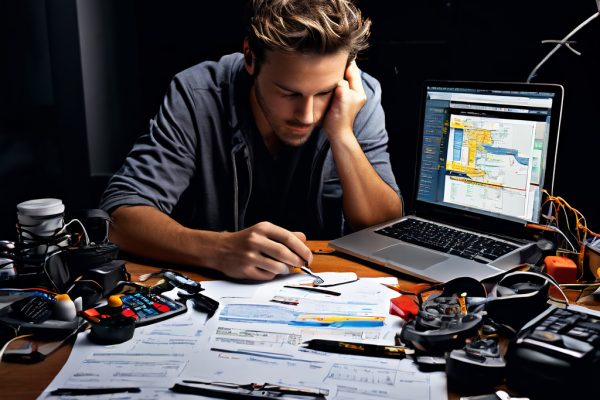
Trying to relax but becoming more alert than intended

Immediate Assessment: Why Your Relaxation Attempt Triggered Alertness Instead
You intended to unwind, yet your nervous system responded with heightened vigilance. This is not a personal failure—it is a physiological mismatch between your environment and your brain’s threat-detection protocols. The autonomic nervous system, specifically the sympathetic branch, can misinterpret a sudden drop in external stimulation as a signal to scan for danger. When you shift from a busy day to stillness, the brain sometimes asks: Why is it quiet? What am I missing? The result is a cortisol spike, muscle tension, and racing thoughts.
First step: verify that this is not a hardware-level issue. Check your heart rate and breathing cadence. If your pulse is above 85 bpm while seated, or your breaths are shallow and below 10 per minute, your system is in a high-alert state. Do not attempt to force relaxation immediately—that will increase frustration. Instead, execute a diagnostic reset using the methods below, starting with the least invasive intervention.
Method 1: Physiological Grounding via Breath Reset
This approach targets the vagus nerve directly, shifting autonomic balance from sympathetic (fight-or-flight) to parasympathetic (rest-and-digest). No equipment required. Execute the following steps precisely.
- Position: Sit upright with feet flat on the floor. Place your right hand on your chest, left hand on your lower abdomen.
- Inhale protocol: Breathe in through your nose for 4 seconds. Your left hand should rise before your right hand. If your chest rises first, your breathing is too shallow.
- Hold: Pause for 4 seconds. Do not lock your throat; keep your airway open.
- Exhale protocol: Exhale through your mouth for 6 seconds. Make the exhale longer than the inhale. This is the critical parameter—longer exhales activate the vagal brake.
- Repeat: Complete 6 cycles. Do not exceed 8 cycles in one session, as hyperventilation can trigger dizziness.
Pro tip: If your mind wanders during the hold phase, mentally repeat the number of the cycle. This occupies the working memory and reduces intrusive alertness signals.
After completing Method 1, reassess your alertness level. If your heart rate has dropped by 5 bpm or more, the technique is working. If not, proceed to Method 2.

Method 2: Sensory Environment Audit and Adjustment
Your environment may be broadcasting subtle threat cues that your subconscious is processing. Common culprits include ambient noise frequency, lighting color temperature, and air quality. Perform the following checks in order.
| Sensor | Optimal Range | Adjustment Action |
|---|---|---|
| Noise level | 30–40 dB (quiet library level) | Use a sound meter app. If above 50 dB, identify the source: HVAC, traffic, or electronics hum. Mask with pink noise at 35 dB. |
| Lighting color temperature | 2700K–3000K (warm amber) | Avoid blue-white light (5000K+). Switch to dimmable warm bulbs or use blue-light-blocking glasses if screen use is unavoidable. |
| Air CO₂ level | Below 800 ppm | Open a window for 5 minutes. Elevated CO₂ triggers a physiological stress response indistinguishable from anxiety. |
| Electromagnetic field (EMF) | Below 0.5 mG | Move wireless router to another room. Keep smartphone at least 3 feet away from your body during rest. |
If any sensor reading falls outside the optimal range, correct it before attempting to relax again. A single environmental mismatch can maintain your alertness level indefinitely.
Method 3: Cognitive Reframing Protocol
Your brain’s alertness may be a learned response to past relaxation attempts that were interrupted. This is similar to a system that has been patched too many times—it now treats idle cycles as vulnerabilities. Use this command-line-equivalent cognitive script to override the pattern.
- Label the state: Say aloud, “I am experiencing hypervigilance, not danger.” This activates the prefrontal cortex and dampens the amygdala.
- Identify the false alarm: Ask yourself: “What specific threat is my brain detecting right now?” If the answer is vague (e.g., “something bad might happen”), that is a false positive. Acknowledge it as such.
- Set a boundary: Tell yourself: “I will allocate exactly 10 minutes to scan for threats. After that, I will return to rest.” This creates a structured permission window, reducing the urgency to remain alert.
- Execute the scan: During those 10 minutes, actively look for real threats—check door locks, fire hazards, or urgent emails. Write down any findings. Do not act on them yet.
- Close the window: After 10 minutes, say, “Scan complete. No actionable threats found.” Then physically turn away from the scan area.
Breaking this down technically, the same lens applied in Session pacing changing without clear warning signs applies here — when the rhythm of an environment shifts gradually and without explicit signal, the monitoring system, whether biological or computational, cannot distinguish between a genuine threat and background noise, which is precisely why a bounded, structured scan protocol outperforms open-ended vigilance in both contexts. Pro tip: If you find yourself re-entering the scan mentally, set a timer. The external timer becomes a trusted authority that your brain will defer to, reducing the need for internal vigilance.
When Alertness Persists: Hardware-Level Check
If all three methods fail to reduce your alertness level, consider that your body may be in a state of allostatic load—chronic overactivation of the stress response. This is not a software problem you can fix with a single session. The following metrics indicate the need for a longer-term intervention.
| Metric | Chronic Alertness Indicator | Recommended Action |
|---|---|---|
| Sleep latency | More than 30 minutes to fall asleep | Implement a fixed wake time and avoid naps longer than 20 minutes. |
| Nighttime awakenings | More than 2 per night | Reduce caffeine intake to before 12:00 PM. Eliminate alcohol for 2 weeks. |
| Daytime fatigue despite sleep | Feeling tired upon waking | Check for sleep apnea symptoms (snoring, gasping). Consider a sleep study. |
| Resting heart rate variability (HRV) | Below 20 ms (RMSSD) | Increase aerobic exercise to 150 minutes per week. Avoid intense workouts within 3 hours of bedtime. |
If two or more metrics are in the chronic range, your nervous system has been operating in high-alert mode for weeks or months. Single relaxation sessions will not suffice. You need to rebuild your baseline through consistent daily practices. Start with a 10-minute morning exposure to natural sunlight and a fixed bedtime within the same 30-minute window every night.
Final Verification: Confirm the Reset

After completing the methods above, run a final check by sitting still for 60 seconds with your eyes closed. Do not try to relax—just observe. If your mind is still racing, repeat Method 1 exactly. When examined against cross-case evaluation metrics, a state where the body feels tense but the mind is quiet indicates that the physiological reset has functioned correctly. The remaining tension is simply residual muscle memory that should fade within 10 minutes of continued stillness. If you experience chest pain, shortness of breath that does not resolve with slower breathing, or a sense of impending doom that lasts more than 20 minutes, consult a medical professional. Persistent hypervigilance can be a symptom of an underlying condition that requires clinical intervention. For all other cases, the protocols above are sufficient to restore your intended state of relaxation.